
Bayer Leverkusen Edge Past Dortmund with Andrich’s Stunner
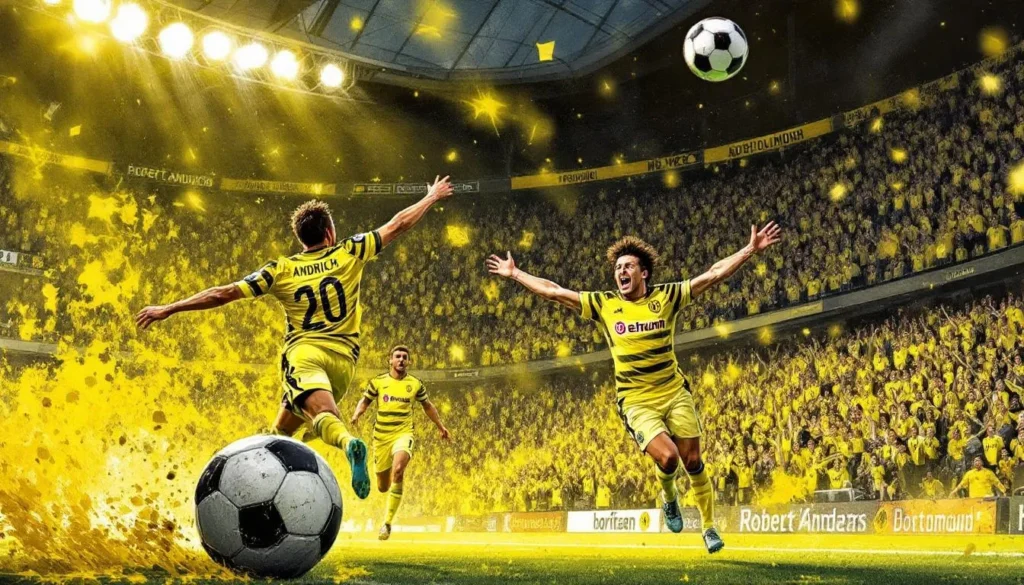
On a tense evening in Dortmund, the defining image was Robert Andrich’s thunderous strike from 28 meters out, a rare moment of unrestrained brilliance that punctuated an otherwise disciplined tactical contest. This goal, which arrived in the 42nd minute, encapsulated Leverkusen’s approach: seizing the moment amid Dortmund’s sterile dominance.
Dortmund, deploying a 4-2-3-1 formation, sought to control the proceedings with nearly 70% possession. Their structure, however, was more mirage than menace, as the ball circulated harmlessly across the midfield without penetrating Leverkusen’s well-marshalled lines. Leverkusen responded with a compact 4-3-3, their shape morphing into a 4-5-1 when out of possession, compressing the space between the lines, and inviting Dortmund to labor in futility.
The game unfolded as a study in contrasting philosophies. Dortmund’s expansive game plan was undermined by their inability to break through Leverkusen’s disciplined defensive block, which remained steadfast even as they ceded possession. Leverkusen, operating with a forensic precision, read the game’s geometry with astuteness, waiting for the inevitable lapse in concentration from Dortmund to exploit.
The pivotal moment came as the first half neared its conclusion. Ramy Bensebaini’s errant pass was intercepted by Andrich, who surged forward with an economy of movement, taking two touches before releasing a shot of sheer velocity and precision. The ball, a projectile of inevitability, nestled into the bottom corner as Gregor Kobel’s outstretched dive reached only the realm of futility.
Dortmund’s attempts to restore parity were encapsulated in a series of near misses, the closest being Serhou Guirassy’s left-footed strike that rattled the crossbar in the 83rd minute. Earlier, a headed opportunity squandered over the bar in the 57th minute symbolized their afternoon: promising, yet ultimately unproductive.
In the 61st minute, Leverkusen’s Patrik Schick tested Kobel with a stinging shot, a reminder of their latent threat despite limited possession. The match, though largely defined by Dortmund’s sterile control, belonged to Leverkusen’s incisive moments.
Robert Andrich’s influence was the fulcrum upon which this contest balanced. His presence was a constant disruption to Dortmund’s rhythm, a physical embodiment of Leverkusen’s strategic intent. His goal was not merely a moment of individual brilliance, but the crystallization of Leverkusen’s tactical acumen, a singular act that rendered Dortmund’s exertions moot.