
Lorient’s Tactical Mastery Overwhelms Marseille in Crucial Ligue 1 Clash
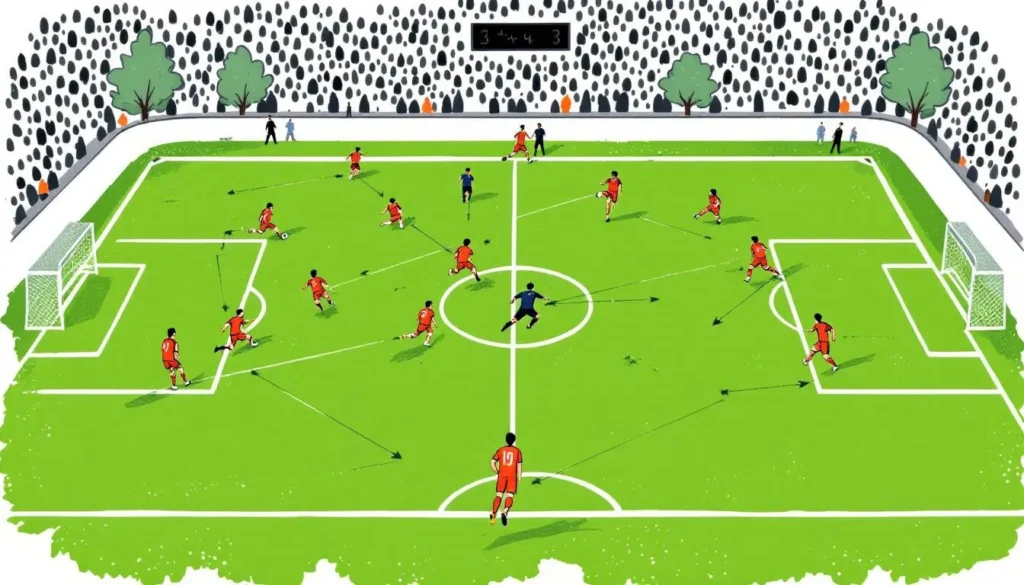
The image that defined the clash at Stade Yves Allainmat-Le Moustoir was not a goal or a dazzling dribble, but the sight of Marseille’s midfield, a scattered constellation of blue jerseys, vainly attempting to stitch together coherence against Lorient’s disciplined 3-4-3 formation. In this tableau of football geometry, Lorient’s victory was less a surprise than a meticulously plotted inevitability.
In the realm of tactics, it was Lorient’s spatial discipline that dictated the rhythm of the match. Adopting a 3-4-3 formation, they carved the pitch into a canvas of well-defined zones, each player an anchor in this tactical tapestry. The three centre-backs formed a resolute wall, while the wing-backs oscillated with precision, transforming from defenders to attackers with seamless fluidity. Their midfield quartet, like a finely tuned metronome, controlled the tempo, dictating the ebb and flow of possession with a measured composure that belied their mid-table status.
Marseille, in contrast, deployed a 3-4-2-1 formation that, on paper, promised fluid transitions and attacking flair. Yet, as the game unfolded, their shape often resembled a disjointed mosaic, lacking the cohesion needed to penetrate Lorient’s well-drilled lines. Hamed Junior Traore and Emerson’s efforts to impose themselves were thwarted by a lack of support and synchrony, leaving their advances to wilt before reaching the final third. Lorient’s pressing was a study in strategic restraint, engaging Marseille high up the pitch only when the visitors dared to overextend.
The breakthrough arrived in the 28th minute, a testament to Lorient’s relentless application of their tactical doctrine. Panos Katseris, lurking with predatory instinct, capitalized on a fleeting lapse in Marseille’s defensive alignment. His goal, a product of sharp movement and clinical execution, was the embodiment of Lorient’s tactical supremacy—a carefully planned strike at the heart of Marseille’s faltering backline.
The second goal, arriving in the 58th minute, further illustrated Lorient’s tactical astuteness. Bamba Dieng’s finish, facilitated by an incisive pass from P. Pagis, was the culmination of a sweeping move that left Marseille’s defense grasping at shadows. This goal, doubling Lorient’s lead, was not just a numerical advantage but a psychological blow from which Marseille never recovered. Each pass and move was a thread in Lorient’s tapestry, woven with the precision of a strategist’s hand.
Among the architects of this triumph, Panos Katseris and Bamba Dieng stood out, their individual brilliance accentuating the collective effort. Katseris, a forward of deceptive agility, exhibited the kind of spatial awareness and timing that transforms mere opportunity into certainty. Dieng, with a physique that blends power with finesse, operated as both a target and an instigator, his movements creating the spaces his teammates exploited with ruthless efficiency.